

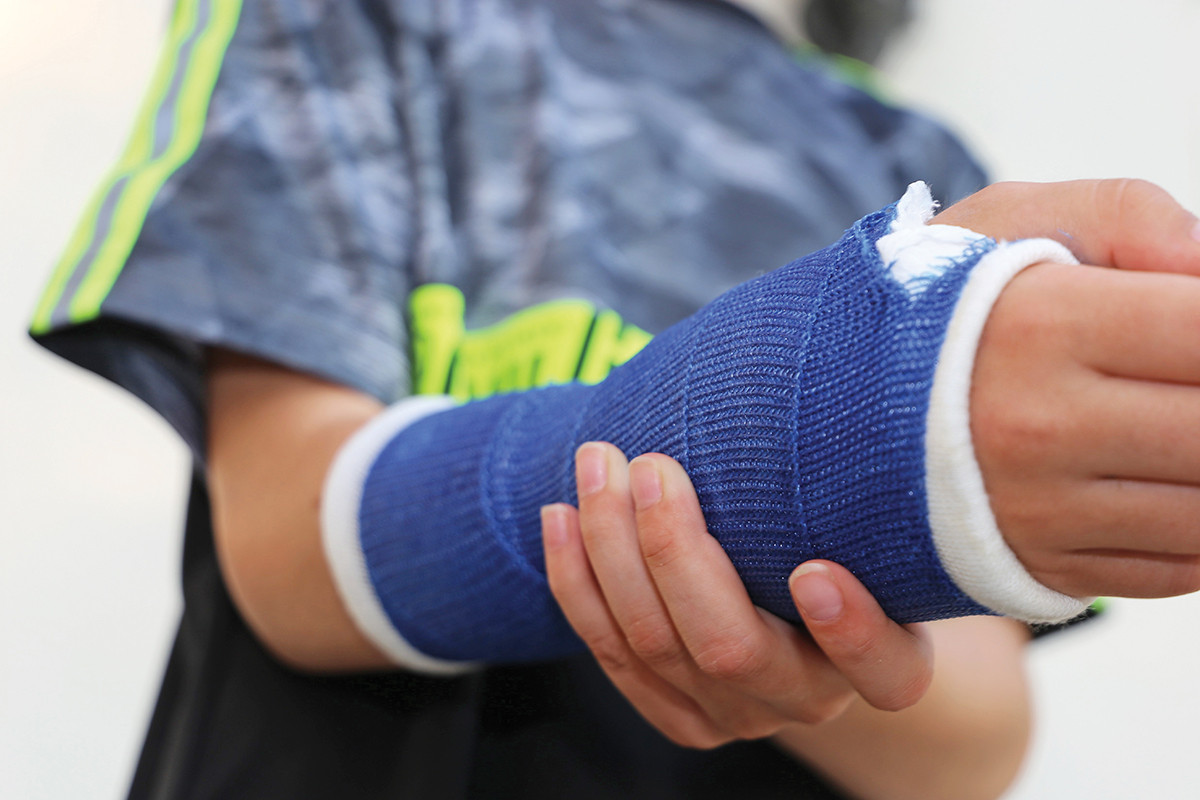
It’s no secret as you shuttle kids to and from practices and games: Kids’ sports are huge, with about 46 million children participating each year. Unfortunately, sports injuries are also common, with more than 3 million kids injured annually.
But involvement in sports doesn’t mean your kid is destined to get hurt: there are many ways to help your child stay safe. Overuse injuries are one of the most common in kids’ sports. They can happen when a child plays the same sport all year, using the same muscles over and over without rest. “These can cause pain, swelling, or limited joint movement,” says Mark A. Rieger, MD, senior pediatric orthopedic surgeon at The Pediatric Orthopedic Center in Cedar Knolls, Springfield and Wayne. “Pediatric orthopedists treat them by identifying the cause and recommending rest, activity changes, or special exercises to help them heal.”
Encouraging kids to try different sports is helpful because then they aren’t repeating the same motions. “We see many kids who concentrate on one sport, such as baseball, who end up with their dominant shoulder and elbow affected, while their legs aren’t getting as much work. With soccer, they’re using the lower muscles, not the upper,” says Jason Womack, MD, chief of the Division of Sports Medicine and head team physician at Rutgers University Athletics. “When you have a child specializing in a specific sport, you’re going to see overuse injuries. Planned periods of rest are essential.”
In addition to overuse injuries, other common sports injuries include:
BROKEN BONES: “The skeletal system is not mature in kids, so they’re at high risk for broken bones because the bones are not completely formed and fused at the growth plates,” says Womack.
SPRAINS AND STRAINS: Sprains refer to ligaments that are stretched or torn, while strains are when muscles are injured. “We see a lot of twisted ankles and knees in kids, as well as wrists and fingers,” says David Gealt, DO, assistant director of medicine at Cooper Bone and Joint Institute.
CONTUSIONS: These are bruises caused by a direct blow to the body, a fall, or a collision on the playing field, says Gealt.
CONCUSSIONS: “About 10 percent of concussions are sports-related,” says Gealt.

HOW TO PREVENT SPORTS INJURIES
Of course, you can’t protect your child from everything, but there are a few ways to ensure he or she is ready for play:
Have your child try various sports. “The most important thing is to have your kid involved in different sports, not just one,” says Womack. “They’re not training other muscle groups when they use same motions repeatedly, which leads to overuse injuries.” These injuries include Sever’s disease, which causes heel pain and is common in jumping sports like basketball; Osgood-Schlatter disease, which is knee pain and also is common in running and jumping sports; and throwing injuries in the elbow.
Make sure your child participates in a pre-season fitness routine. “You don’t want your kid to go from couch potato to intense activity,” says Gealt. Help them learn the appropriate sports-specific warmup routines before they start playing. That can be formal training led by the coach, or something as simple as running around the backyard playing catch or going to the batting cage.
Keep gear in good shape. Kids should wear appropriate and properly-fitted gear such as protective pads, helmets, eye protection, protective cups, face guards and mouthpieces.
Teach kids to speak up. If they’re hurt, they should say something and not try to play through the pain, says Womack.
Work on flexibility and strength. Stretching after games and practice can increase flexibility, while conditioning exercises build muscles.
Plan periods of rest. Kids should have days off each week, as well as time in between seasons. “Even professional athletes take time off to rest and recover,” says Gealt.
Keep kids hydrated. Kids should drink water before, during and after exercise to prevent dehydration—in both hot and cold weather.
HOW TO HELP YOUR KIDS RECOVER FROM SPORTS INJURIES
For soft tissue injuries such as strains and sprains, you may be able to treat at home. Remember the mantra RICE: rest, ice, compression, elevation. Have kids rest; ice the area for 20 minutes a few times a day (but don’t put ice directly on the skin); use an elastic compression bandage to prevent swelling; and elevate the injured area above the heart.
You can also give your child an age-appropriate dose of an anti-inflammatory, such as Tylenol, for pain. “Try home care for a day or two, but if the pain persists or gets worse, see your child’s doctor right away,” says Womack. Ditto if your child can’t bear weight on an injury or can point to a specific spot that hurts.
For injuries that have been treated by immobilization, such as a broken bone, ask your child’s doctor about a referral for physical therapy, even if just for a few sessions. “This can help your child learn exercises to regain range of motion,” says Gealt.
Kids who are diagnosed with a concussion need to follow the doctor’s recommendations for both physical and mental rest. “We’ve come a long way in understanding and treating concussions in the last two decades. It’s important for parents to understand that kids should not return to play or return to learning too soon,” says Gealt.
— Arricca Elin SanSone is a health and lifestyle writer.
Get the latest on the best things to do with your family in and around New Jersey by signing up for our newsletter and following us on Pinterest, Facebook and Instagram!
Read More:
Back to School Events in NJ: Sales, Swag and More
Preschoolers Can Go to Adventure Aquarium for Free
9 NJ High Schools Rank Among the Best in the Country (2025-2026)
Popular Now:
How to Hit the Jersey Shore Like a Local
New Jersey Ranked 3rd Best State to Live in for 2025! Do You Agree?
New Jersey’s 3 Best “Bougie-on-a-Budget” Vacation Spots, According to Survey
These 2 NJ Downtowns Were Just Named Among the Most Walkable in the U.S.

