

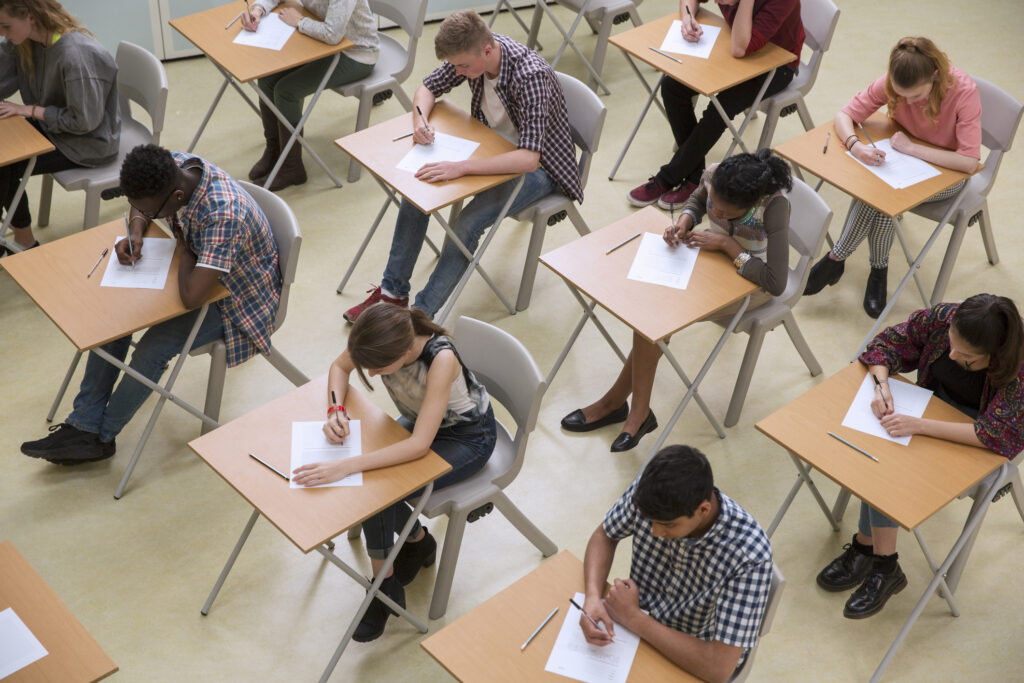
 The New Jersey Department of Education recently released results from this past spring’s Student Learning Assessments, and while students are holding steady in English and Science, math readiness remains a significant concern statewide.
The Results
The reports show some improvement in test scores since the pandemic, but math readiness remains low. The following statistics were shared during the December 3 state Board of Education meeting, where the scores were discussed.
From 2016 to 2025, the percentage of students in all grades who met or exceeded expectations in English as Language Arts (ELA) increased slightly overall. However, from 2019 to 2022, the percentage dropped nearly 9 points.
During the same time period, the percentage of students who met or exceeded expectations in math in all grades decreased by less than 1 percentage point. Still, from 2018 to 2022, math proficiency dropped by nearly 10 points. Math scores for grades 3 to 8, as well as Algebra 1, followed a similar pattern: scores fell by nearly 3 points from 2016 to 2025, and by 11 points from 2018 to 2022. However, there have been “significant improvements” in geometry and Algebra 2, according to information provided by the New Jersey Department of Education Office of Communications.
Since 2019, science scores dipped slightly in 2022, but have steadily climbed through 2025 across all grades.
Grade 11 data from the New Jersey Graduation Proficiency Assessment shows that in 2023, 80.5 percent of New Jersey high juniors met graduation readiness benchmarks in ELA, while 19.5 percent did not. By 2025, that number rose slightly, with 81.3 percent of students deemed ready and 18.7 percent not ready.
Math scores tell a different story. Although Grade 11 math scores increased year over year, overall readiness is still low. Just 55 percent of high school juniors demonstrated graduation-level math skills in 2023. That number rose to 58.5 percent in 2025. That means that despite those gains, a significant share of New Jersey public high school juniors are still falling short of the state’s math benchmarks.
It’s important to note there were no standardized tests administered in 2020 or 2021 due to the COVID pandemic.
The Story Behind the Numbers
Laura Overdeck, the founder of Bedtime Math (a nonprofit dedicated to increasing kids’ math skills and confidence) and co-founder of Wake Up Call New Jersey (another nonprofit that educates public school parents about their children’s schools and test scores and advocates for solutions) said that while the pandemic disrupted learning, math scores had already started falling as far back as 2018. She said scores among the top 10 percent of students have mostly remained flat, while performance among lower-achieving students has continued to decline.
“It’s nowhere near where we were before COVID, but before that we were not where we should’ve been,” she said.
Aside from the effects of the lockdown, an increased reliance on technology and social media has been “eroding” our kids, Overdeck said, based on 25 years of data. She said there is an accumulation of systemic problems, including the fact that there is no standardization in terms of mastery of areas on a test, or how often students are tested.
Grade inflation by teachers is also a huge issue. According to Learning Heroes, 90 percent of students get As and Bs, but half are actually below grade level, with no indication of if they’ve mastered the subject.
“The grade doesn’t necessarily tell you how your child is learning,” Overdeck said.
There are also falling SAT, ACT and College Board scores. And unfortunately, sometimes the diploma doesn’t match the skillset upon graduation, she said.
Economic disparities also play a role. Enrolling kids in afterschool activities translates to higher scores, Overdeck said. She cited small sports teams, private music lessons, joining the chess or math club, or being led by likeminded parents on a robotics team, as enriching for kids. “But afterschool access does correlate with income,” she said.
Initiatives By the State
In order to help students succeed, New Jersey instituted evidenced-based literacy concepts in English and core data literary concepts in math to strengthen foundations, according to the December 3 presentation at the State Board of Education meeting. The state is targeting younger learners, too, by increasing foundational reading skills from preschool to grade 6, and requiring literacy screeners twice a year from kindergarten to grade 3.
Over $52 million was invested in English and math tutoring in 300 districts, targeting 70,000 students, in 2024 and 2025. Since 2023, $4 million has been invested in elementary literacy efforts. A $50 million grant has been put toward support for district-level coaches, the purchase of high-quality instructional material, support for family engagement in literacy starting at birth, and help for kids who are not reading at their grade level.
Teacher training programs are updating their courses, so future teachers learn how to teach reading in every subject. Also, colleges and universities that prepare teachers are now required to include literacy instruction across all content areas in their teacher preparation programs, according to information provided by the New Jersey Department of Education Office of Communications.
And, New Jersey state tests are now adaptive, meaning the questions adjust as students work through the test.
What Parents Can Do
Overdeck says that Wake Up Call New Jersey is working to help parents understand where their children stand academically. First off, Overdeck says releasing standardized test scores in the fall means families lose valuable summer time to address gaps, making it especially important to closely monitor their children’s progress.
Parents can tap into their school’s digital portals – though Overdeck said they aren’t always user-friendly – and use them more. There are tests taken throughout the year where parents can check ongoing scores.
Parents can also hire a tutor, which has been proven to boost academic improvement, but tutors can be expensive, and there is a discrepancy in terms of economic levels. During the pandemic, Overdeck helped launch the NJ Tutoring Corps to provide tutoring opportunities to kids who are below grade level and do not have the financial resources to get extra academic support.
Because of the discrepancy in math scores, Wake Up Call has a program called Math Checkups. For example, ask your little one to count to 6 – if you hear them whisper “1-2-3-4-5-6” that means they memorized the numbers and don’t actually know how to count. Or, if you ask your 4th grader what year Grandma was born if she is age 73, and they can’t do four-digit substraction, their skills need some improvement.
“We are truly in this to help kids in public school,” Overdeck said. “We’re just here to get parents of public school kids to dig in and see if their kid is on grade level, because half are not.”
She also noted that this is a systemic problem, and no one person should be blamed, but the process must be fixed. “We believe educators are well-intentioned and we all need to work together and figure this out,” she said.
Wake Up Call New Jersey has many resources on its website, including a list of questions to ask during parent-teacher conferences.
To watch the New Jersey State Board of Education meeting from December 3, click here. The discussion on the Student Learning Assessments begins around 1 hour and 14 minutes.
To download the results from each school for the past several years, click here.
Detailed school and district data, including assessment data, will be available in the NJDOE’s annual School Performance Reports, typically released each spring.
Get the latest on the best things to do with your family in and around New Jersey by signing up for our newsletter and following us on Facebook and Instagram!
Read More:
11 Schools Receive Blue Ribbon Awards From New Jersey Department of Ed
Help Your Kids Beat Test Stress With These Game-Changing Tips
Top 50 Public Elementary Schools in NJ, According to U.S. News & World Report

