

New Jersey has its first reported case of measles for 2026 and health officials are once again urging parents to check the vaccination status of their kids (and themselves) to make sure they are up to date.
The single confirmed case is a resident of Hudson County who was diagnosed with measles after traveling internationally, according to the Department of Health on April 22. The person traveled through Terminal B of Newark Liberty International Airport between 5:30 and 9 am on April 14. The person also visited the Pediatric Emergency Department of Hackensack University Medical Center in Hackensack between 11:15 pm April 17 and 3:15 am April 18.
As of April 22 no additional cases were reported, but if you were at either the airport or hospital during those times, you are urged to contact your doctor. You could develop symptoms as late as May 11.
Measles is a very contagious respiratory disease that spreads easily when someone coughs or sneezes, and the virus can remain in the air for up to two hours after an infected person leaves the area. Plus, you have to make sure you avoid any mucus or saliva from an infected person. It is especially dangerous because 90 percent of people who are exposed to someone with the virus will catch it if they are not vaccinated, according to the New Jersey Department of Health’s (NJDOH) Communicable Disease Service.
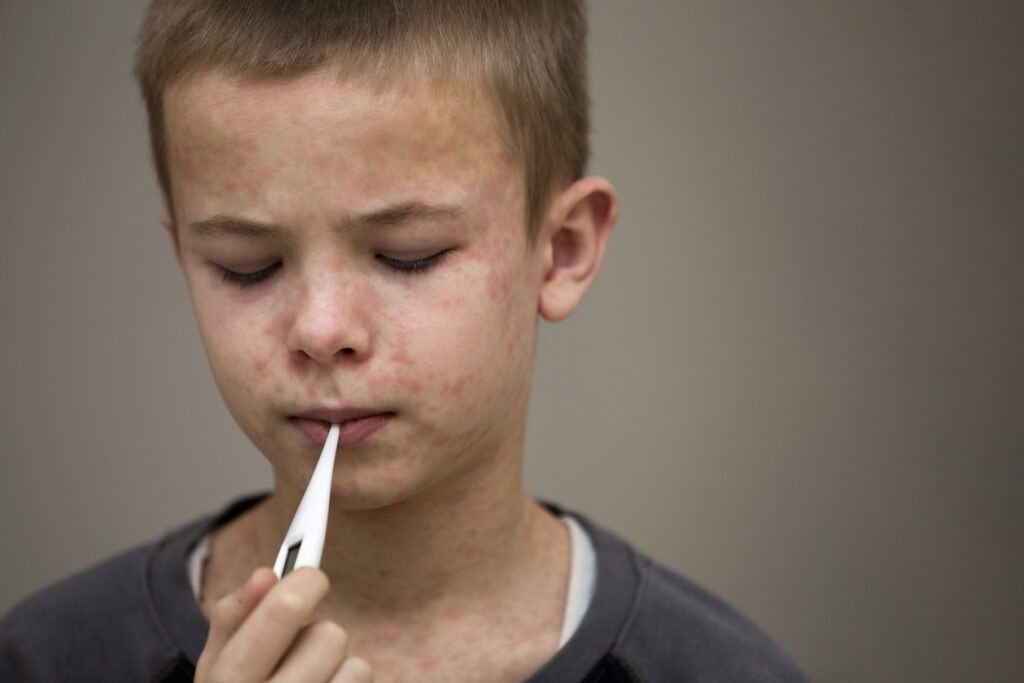
It is considered the most deadly of all childhood rash/fever illnesses, so if your child is not vaccinated, look out for the very telling rash, which usually begins as flat red spots that appear on the face at the hairline and spreads downward to the neck, torso, arms, legs and feet. Your kid will probably also have a high fever, cough, runny nose and red watery eyes.
Measles can also cause ear infections, pneumonia, swelling of the brain, and miscarriage in pregnant women.
You can have the measles for 7 to 14 days before you have symptoms; then have a fever, cough and runny nose for the next two to four days; and then a rash for three to five days – that means you can be contagious from four days before the rash appears until four days after it subsides.
A common treatment is taking a fever reducer, keeping hydrated and letting your child rest. Call your doctor if you see any serious signs of illness.
One in 5 people who get measles end up hospitalized, and 1 to 3 out of every 1,000 infected children will die from complications, per the CDC.
The most effective way to prevent measles is with the MMR shot (measles, mumps, rubella), which is usually given in two doses, according to the Centers for Disease Control and Prevention: the first is at age 12 to 15 months, and the second is at age 4 to 6; your kids can get the second dose at least 28 days after the first if you’re worried about the current outbreak. This applies to adults as well. Babies who will be traveling internationally could get their first dose as soon as 6 months, and then two more doses after their first birthday; consult with your pediatrician.
According to the CDC, studies show that 95 percent of measles cases are among kids and adults who had not received the MMR vaccine or whose vaccination status is unknown.
Last year, New Jersey reported seven total measles cases. According to the CDC, as of April 23 a total of 1,792 confirmed measles cases were reported in the U.S. already this year.
NJDOH experts urge New Jersey residents who are planning to travel, regardless of the destination, to be current on all routine and travel vaccinations, especially MMR. You can check with the country where you are traveling for other vaccines you may need, such as for malaria, smallpox, hepatitis or polio.
You can check the CDC website every Friday for updates on the measles outbreaks. The American Academy of Pediatrics has been posting updates as well, including its New Jersey chapter.
Get the latest on the best things to do with your family in and around New Jersey by signing up for our newsletter and following us on Facebook and Instagram!
Read More:
What to Say When Your Neurodiverse Child Is Overwhelmed: An Age-By-Age Guide
These Everyday Habits May Be Causing Your Child’s Neck and Back Pain
What Dr. Rachel Goldman Wants Everyone to Know When Life (+ Stress) Happen

