

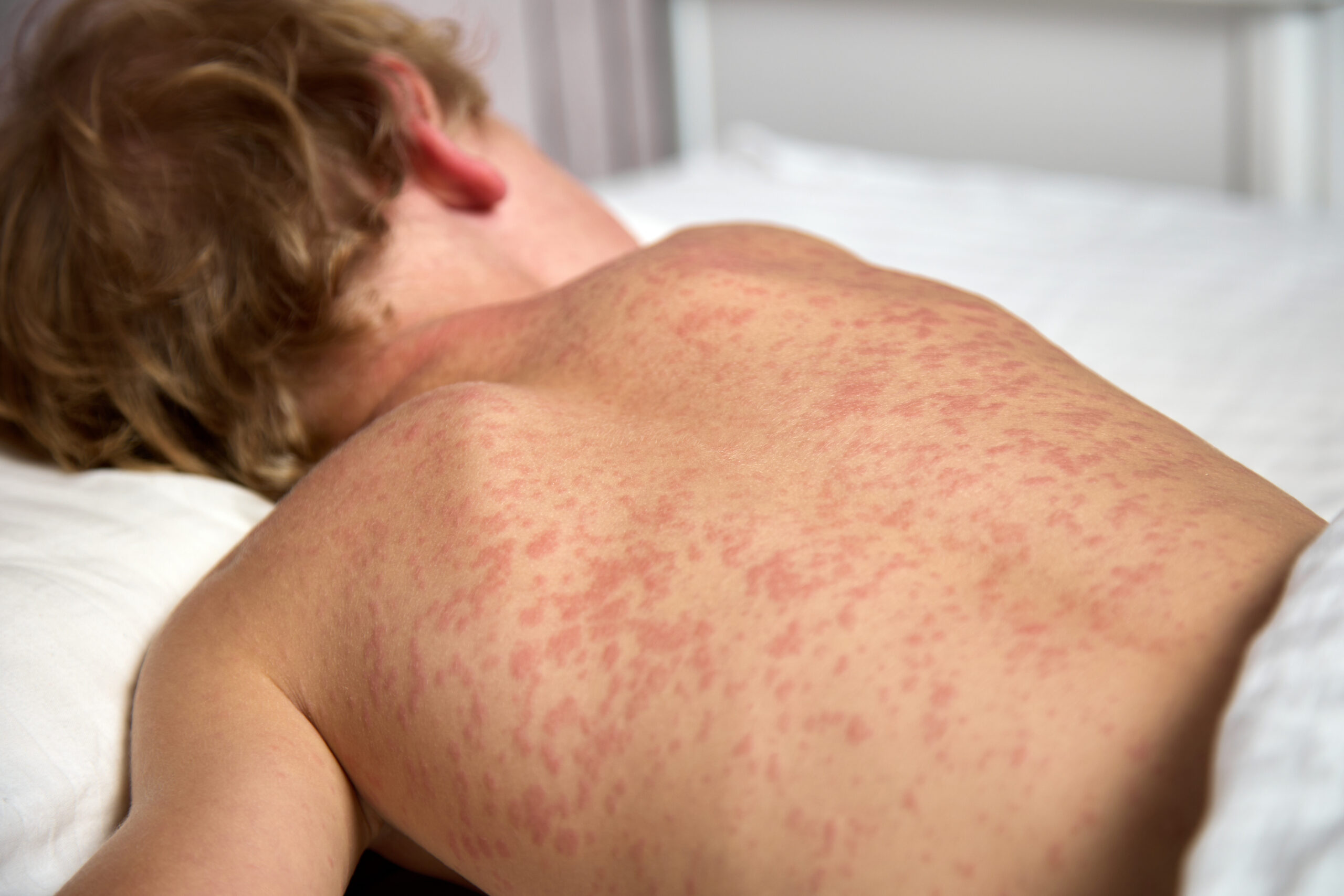
Thanks to the measles vaccine introduced in the 1960s, most of us have never seen this disease firsthand. In fact, according to the Centers for Disease Control and Prevention (CDC), measles was declared eliminated from the U.S. in 2000.
But measles was not eradicated around the globe, and occasional surges do occur in the U.S. due to international travel and decreasing vaccination rates. “We’re seeing the number of cases rising in the U.S. in recent years,” says Anat Feingold, MD, MPH, associate professor of pediatrics and pediatric infectious diseases at Cooper Medical School of Rowan University in Camden. “Ninety-five percent of the population must be vaccinated or the disease can spread. But in some communities now, the immunization rate may be as low as 70 percent.”
In fact, the CDC reports that from the 2019-20 to the 2022- 23 school year, national kindergarten coverage declined from 95 percent to 93 percent for all vaccines, including measles. As a matter of perspective, there were only 285 measles cases in 2024 in the U.S.; last year, the number of confirmed cases in the U.S. was 2,288, with two deaths in unvaccinated children. In 2026, there already have been a number of outbreaks, including one in South Carolina, which is the largest outbreak in decades.
WHY MEASLES IS SO DANGEROUS
Measles is much more than a skin rash. “Measles is one of the most contagious diseases on the planet,” says Margaret Quinn, a pediatric nurse practitioner and clinical professor at Rutgers Health School of Nursing, which has multiple locations. “The virus can be transmitted to 12 to 18 people by one infected person, whereas one person infected with the flu may only transmit to 3 people.”
The virus can stay airborne and live on surfaces for up to two hours when an infected person coughs, sneezes or talks, so you can be exposed even after that person leaves the room, says Quinn. The first symptoms, which start about 8 to 12 days after exposure, include a fever of 104 degrees or higher, a cough, a runny nose and watery eyes, with the red itchy skin bumps appearing a few days later. Kids also may get diarrhea and an ear infection. “During the 1989-90 measles outbreak, I took care of kids who were some of the sickest I’ve ever seen,” says Quinn. “It’s not just a rash.”
There’s also a risk of many potential complications in kids who get measles. “About 1 in 5 kids with measles need to be hospitalized, especially children younger than 5 years old,” says Feingold. Serious complications include pneumonia, which occurs in about 1 in every 20 kids who get measles. Encephalitis, which occurs in about 1 of every 1,000 kids who gets measles, can result in swelling of the brain and deafness. A rare and typically fatal brain condition called subacute sclerosing panencephalitis (SSPE), which occurs 7 to 10 years after a person has measles even though the person seems to have recovered from the illness, is also a risk.
HOW TO PROTECT YOUR CHILD FROM MEASLES
The answer is simple: Make sure your child receives the recommended measles vaccines on time. “This is a preventable disease. This vaccine is effective and eliminates the risks of this serious disease and its complications for your child,” says Feingold. Vaccinating your child also protects other people who cannot be vaccinated, such as people who are immunocompromised.
There are two vaccines: MMR, which contains a combination of measles, mumps and rubella vaccines; and MMRV, which contains measles, mumps, rubella and varicella (chickenpox) vaccines. Two doses are 97 percent effective against measles, and immunity is lifelong for most people.
The current recommended dosing for children is as follows:
- First dose: 12 to 15 months
- Second dose: 4 to 6 years old
With the risks of international travel, the CDC offers a travel website that lists current health notices and risks for specific countries, including for countries where measles is a concern. If you will be traveling to a country where measles is endemic, talk to your pediatrician. Your baby ages 6 to 11 months old can receive their first MMR vaccine at least two weeks before travel, says Quinn. However, your child still will require the standard 12-month dose, as well as a second dose between the ages of 4 and 6 years.
—Arricca Elin SanSone is a New York-based health and lifestyle writer.
Get the latest on the best things to do with your family in and around New Jersey by signing up for our newsletter and following us on Facebook and Instagram!
Read More:
NJ Reports First Case of Measles for 2026. Here’s How to Protect Your Kids

