


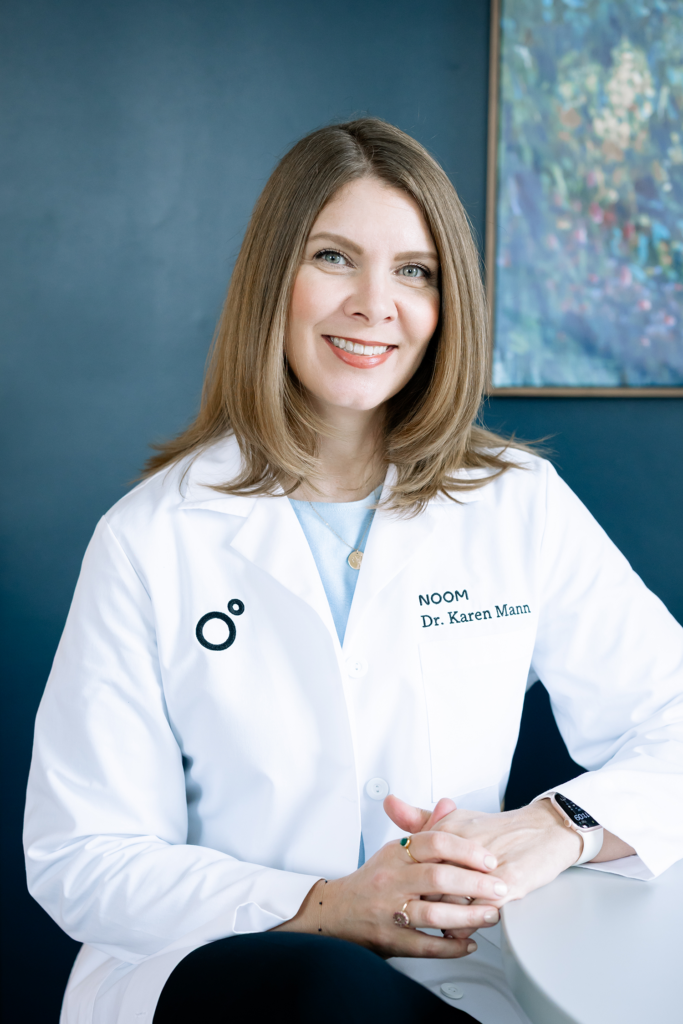
In anticipation of the upcoming Let’s Talk Women’s Health & Wellness Symposium on March 14 at NJPAC, Let’s Talk spoke with Dr. Karen Mann, Medical Director at Noom, about her work in women’s health and weight management.
Dr. Mann will be part of the panel for the breakout session “The Truth About Weight Loss Medications, Metabolic Health & Nutrition,” which will explore GLP-1 medications, metabolic health, nutrition, and long-term wellness. She will be joined by Vanessa Freeman (moderator), anchor, WPIX Morning News; Vanessa Risetto, co-founder and CEO, Culina Health; Dr. Sheila Sahni, interventional cardiologist and director, Women’s Heart Program, Sahni Heart Center-Hackensack Meridian Health; and a representative from Horizon Blue Cross/Blue Shield of New Jersey.
Looking Beyond Quick Fixes
Dr. Mann, a board-certified OB/GYN and obesity medicine specialist, has developed an uncommonly broad yet synergized spectrum of knowledge. She started as what she describes as a “traditional gynecologist,” but kept feeling that what she was providing was more of a “Band-Aid” fix for women.
A life coach and Menopause Society-certified practitioner, Dr. Mann wanted to figure out the root causes of the issues, the changes, that a woman faces as she ages. She experienced her own personal weight loss journey and came to understand firsthand the emphasis our culture has on physical appearances, and how difficult it was to find a long-term solution to weight management.
As she approached midlife, it became clear to her that many practitioners lacked an adequate degree of education on menopause, and how to help their patients through the often uncomfortable and sometimes life-disrupting changes that come with it.
Dr. Mann set out to unravel what the traditional western medical ideology was around these topics, with the hope that she might discover that something different, something much more innovative, was possible. In terms of her personal experiences with the physical and emotional changes and challenges a woman goes through, she said she drew a lot from intuition, a kind of inner wisdom.
“It’s become more of a gathering of internal knowledge I accumulated over years of trial and error,” said Dr. Mann, who holds a certificate in nutrition science from Stanford University. “And figuring out that as much as I track my calories, try to get to the gym, and understand my hormones; at the end of the day, there’s really something deeper that influences all of those behaviors—something that is actually more effective than all the other things that I could be doing on the surface.”
“Self-love” is firmly rooted in Dr. Mann’s approach, though she admits it has become kind of a buzz word. But motivation, taking action, and changing your lifestyle for better health and a better life isn’t just about appearance; it’s about feeling your best and building a loving relationship with yourself.
“We’re constantly feeling like we’re having to compare how we look to an ideal that’s really not obtainable,” said Dr. Mann. “I think that beats us down. My goal is to help people understand that true growth comes from getting underneath what you look like on the surface. Show up to the world the way that you are, the way that you look, but be able to draw on something deeper inside that can really carry you and bring meaning to your life and give you room to grow.”
That said, being told just to love yourself in a doctor’s office does not always land well. Dr. Mann is in the unique position at Noom to be able to “marry science” to some of the deeper themes around understanding your worth, which is more powerful in motivating changes in behavior.
But besides understanding you worth, understanding what’s happening is essential—figuring out what really is underneath your pattern of behavior, and that everything you’re doing is meeting a need. “Every time you reach for a food that your body or mind says you shouldn’t have, you’re reaching for it for a reason,” says Dr. Mann. “It is important not to dismiss the fact that food can be an addiction like any other addiction, and it can be hard to fight it on your own.”
The Science Behind Behavior Change
Noom’s products are developed using evidence-based approaches and scientifically proven principles, such as cognitive behavioral therapy (CBT), to help people build sustainable habits that last a lifetime. As Noom’s medical director, Mann is involved in helping to create medical protocols, so that everything is evidence-based, from the studies. But she also gets to bring in the life-coaching perspective and interact with the content that Noom “puts out there,” the educational component, which is a large part of why Noom is successful.
As someone who came from traditional medicine, seeing patients every day, Dr. Mann said that she was limited to a “bucket of things” that she could pull from to help her patients. At Noom, she finds it nourishing to be able to help people in a very unique and holistic way and have them experience how every entity of their health is being addressed. Their comprehensive weight-loss platform integrates psychology, technology, and coaching to help individuals build healthier eating habits and achieve sustainable weight loss.
For those seeking additional support, Noom can also provide access to weight loss medication for eligible individuals and guidance to minimize long-term reliance on medication.
“We’re living in a reality where medication is a key tool in helping people manage their weight,” said Mann. “And again, it’s not about appearance. These medications may reduce adverse cardiovascular outcomes, protect kidney function, and help break the ‘food addiction’ cycle. They are always prescribed along with a comprehensive lifestyle program that includes behavior change, nutrition, and the pillars of health.”
Dr. Mann jokes that as a Gen X’er, she was raised on “hose water and neglect.” But we’ve come to a point where it’s not okay anymore for us not to pay attention to ourselves and to get the information that’s out there. We deserve to know what is available to us to solve the challenges that are in front of us. The goal is to feel better and to be healthier. Obesity is a chronic illness. Losing the weight improves our health, but it’s more than just that—the process of eating, and the process of caring for the body have so many more components than just taking the medication.
That’s the conversation Dr. Mann hopes to have along with her fellow panelists on March 14 at Let’s Talk. “I’m really excited to be in front of all these women who want to hear about where we are at this point in terms of addressing our metabolic health, and how to think and act differently,” she said. “It’s been a privilege to have the resources to educate myself and then to share what I’ve learned with others. That’s where the joy comes from… getting it out there.”
New Jersey’s biggest day of health and wellness for women, the Let’s Talk Women’s Health & Wellness Symposium will take place March 14 at NJPAC and will feature plenary sessions, breakout discussions, fireside chats, and panel conversations on topics including cancer, fertility, motherhood, menopause, sexual health, mental wellness, and financial health. This is the place for honest, heart-to-heart storytelling, practical health education, unexpected joy, and conversations about every facet of your well-being. The event will also include a wellness lounge and marketplace.
For more information and to purchase tickets, visit www.letstalkwellwomen.org/symposium-2026 and use code NJFAMILY30 to get 30 percent off tickets.
Read More:
8 Things Every Woman Needs to Know to Protect Her Heart Health
What a Yale Student from New Providence Learned Helping Her Mom Through Cancer
5 Actionable Ways to Take Charge of Your Health as a Busy Mom

